Important note: An interdisciplinary activity connects two or more subjects while maintaining their clear boundaries—for example, using Physical Education to apply mathematical concepts. This method will help you design activities where movement reinforces classroom learning in an authentic way.
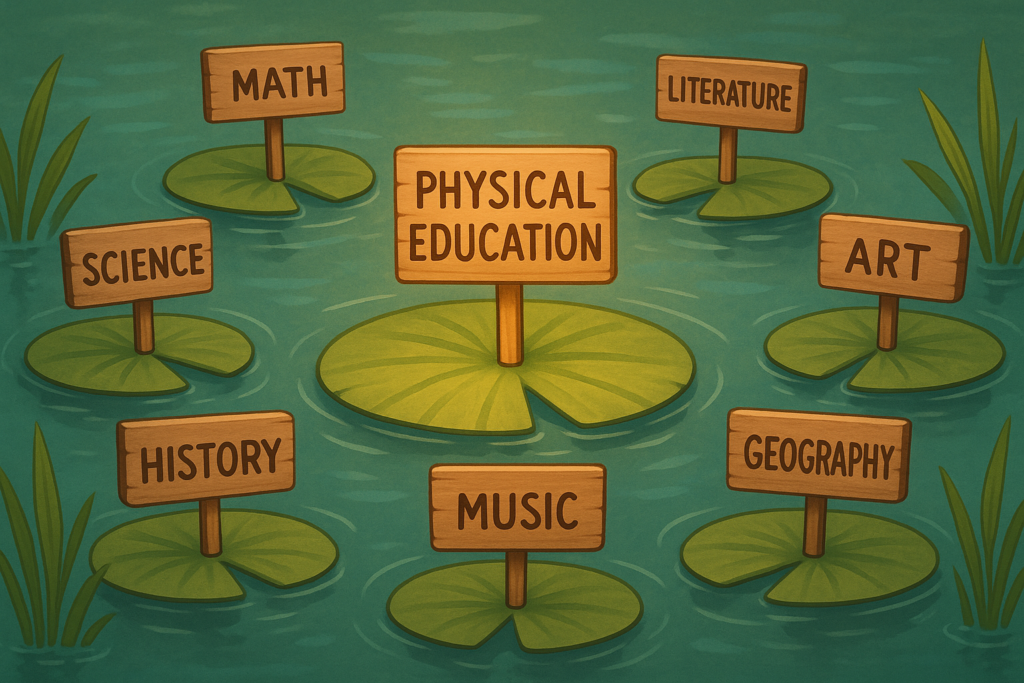
Designing an interdisciplinary activity in Physical Education can seem overwhelming, especially since this approach isn’t always present in every curriculum. However, it’s a great resource for reinforcing knowledge that students are learning in other subjects through movement. Here’s how I design my activities to connect PE with other areas.
To illustrate the process, I’ll use one of the activities from my website as an example: “Polygon Builders.”
- Connection with classroom learning.
The first thing I did was ask the homeroom teacher what topics they were working on. She mentioned they had been learning about polygons and that some students were having difficulties with the topic. Perfect—I already had a connection point for my class.
- Selection of the motor skill
Next, I decided which motor skill I wanted to develop in the session. In this case, I chose jumping, a fundamental skill that fit well with what we had been working on in previous sessions and was mentioned in the PE curriculum of the country where I was teaching for children of that age.
- The key element: teacher creativity
In Physical Education, we want to foster creative thinking in our students, but often the activities we use don’t come from our own creativity—they come from the internet or tools like ChatGPT. To take your classes to the next level, creativity must come from you. That’s what will make your classes unique and memorable.
To generate ideas, I ask myself questions like:
- How can students BE the concept instead of just applying it?
- What motor skill connects naturally with this topic?
- How can I add collaboration or a problem to solve?
After some reflection, the central idea for the activity emerged: have students form polygons using their own bodies, working as a team and organizing themselves autonomously. To do this, I divided the students into groups and, considering their age, established that the goal wasn’t to compete to form polygons as quickly as possible, but to do it correctly and precisely.
- Integration of the motor component
Since the main skill was jumping, I designed a small obstacle course that students had to complete before forming each polygon. This way, we united the motor component with the conceptual component of the activity.
- Initial questions and final reflection
At the beginning, I asked them to identify different polygons according to their number of sides. This was important because the number of students who needed to run to form the shape depended on that information.
At the end, I wanted to make sure they truly understood what a polygon is. To do this, I included shapes that aren’t polygons—like a circle or a heart—and used them as examples during the activity. The students were able to explain why these shapes didn’t meet the criteria.
Results of the activity
The activity, conducted with 7-year-old children, was a success. All of them were able to identify each of the polygons they had formed during the activity in the photos I took of them. Not only did they perfectly understand what a polygon is by becoming one themselves, but they also worked as a team very effectively. Students who weren’t running took charge of organizing the group to form the shape correctly, taking advantage of their outside perspective.
The key difference
The difference between an interdisciplinary activity and a traditional Physical Education class lies in the intention: it’s not about doing exercise AND then asking about math, but rather creating an experience where movement is the best vehicle for understanding the concept. When you achieve this, your students can’t distinguish where PE ends and the other subject begins—and that’s the magic of interdisciplinary learning.
Choose a topic your students are working on in the classroom, identify a motor skill you want to develop, and use this method. And if you have any questions, don’t forget you can contact me through the CONTACT section or through my social media. Let’s transform Physical Education together!


